
Guides
Follow the Water to Its Source: A Decision Guide for Bremen Homes
Water in the house has only a handful of possible sources, and each one points to a different first move. This guide walks from what you see to who to call, drawing on EPA, CDC, the Weather Service, UGA and the Red Cross.
First question: is anything electrical, gas-fired or sagging?
Three yes answers end the guide early. The first is water reaching an outlet, a plug or the breaker box. CDC says never to touch a power switch or run an electric tool while you stand in water. The second is a smell of gas. CDC's advice is to shut the main gas valve, open windows, leave at once and stay away from anything that could spark. The third is a ceiling that sags. The Red Cross calls it wet and heavy, and says a blow to the center may bring the whole thing down.
Each of those calls goes to 911 or the utility, made from outside the room. Georgia Power adds a rule for the yard: stay away from a downed line, and report it to 911 or at 1-888-891-0938. The number on this site is for the steps that come after.
Second question: did it come from a pipe, a drain or the sky?
Look at where the water first showed. A pipe leaves a trail that starts at a wall, a ceiling or an appliance and may keep growing while the taps are off. A drain sends dark water up through the lowest opening in the house: the floor drain, the tub or the toilet. The sky leaves a stain under the roof, wet insulation, or water at a window or the foundation after rain.
The three sources call for different first moves, so spend the minute. EPA's flood page lists bacteria, chemicals and other hazards as things flood water can carry. CDC adds that flooded homes may be contaminated with sewage. That alone puts drain water on a different track from a split pipe or a leaking roof.
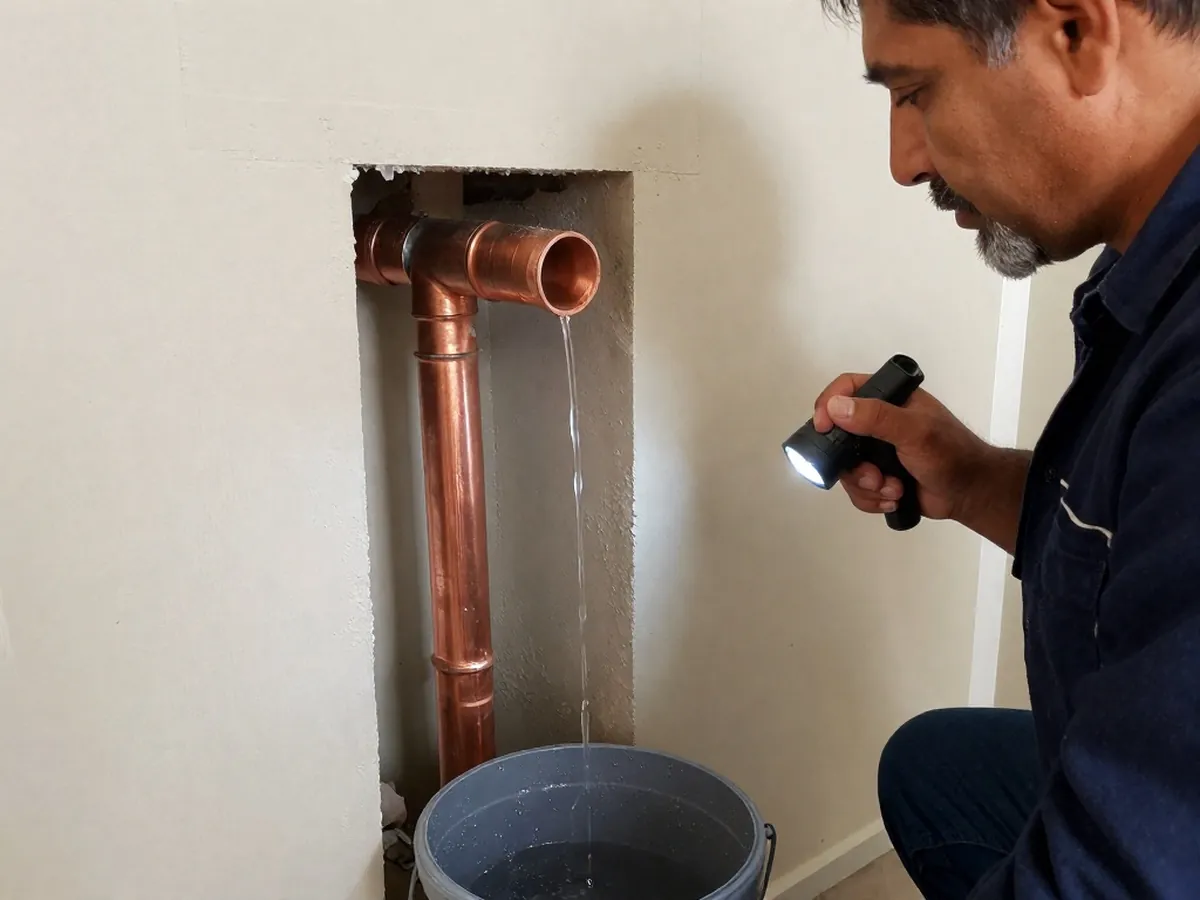
If it came from a pipe: the valve, the meter, then the walls
Close the main valve if it sits in a dry spot. Then use the meter as your witness. EPA's WaterSense page says to read it, use no water for two hours and read it a second time. If the numbers moved, you probably have a leak. A toilet is the usual false alarm, and ten minutes with food coloring in the tank settles it.
If the meter points at a pipe, think about where pipes freeze. The Weather Service names exterior walls, basements, attics and the space under kitchen cabinets. Georgia's insurance department asks for photos before temporary repairs and receipts after, so take the pictures before the mop comes out.
If it came up a drain: keep out and call the town
Treat it as sewage until a professional says otherwise. When sewage caused the damage, EPA says to call in someone experienced with contaminated water. UGA lists sewage as a case where do-it-yourself cleanup does not apply. Pennsylvania's guide says drywall cannot be decontaminated and goes in the discard pile, and NDSU says the same of carpet soaked by contaminated flood water.
The town office comes first, since it can tell whether the main is blocked. Tallapoosa's Public Works maintains sewer mains at 770-574-2345. Bremen's list has no sewer line, so City Hall at 770-537-2331 is the start. The Waco notes and the Temple notes have those two numbers. Homes on septic tanks answer to Haralson's Environmental Health Department at 770-646-4301.
If it came from the sky: roof, gutters and the ground
Rain finds three ways in. The first is the roof, where UGA's checklist looks for missing or curling shingles and moisture in the attic. The second is the gutters and downspouts, which UGA wants clear and aimed to empty well away from the foundation, 6 to 10 feet out. The third is the ground itself, and a basement that fills needs patience. University of Missouri Extension says to pump out about a foot, wait overnight and repeat, because emptying it at once can damage the structure.
The Weather Service says flash floods usually come within 6 hours of heavy rain. It adds that water only 6 inches deep, if it is moving, can topple an adult. A road under water is not a shortcut.
When does a contractor join in?
A contractor joins in after the hazards are dealt with and the leak is stopped. EPA's guide gives a window of 24 to 48 hours for getting wet areas dry again. A floor still damp after the first day is a reason to ask for help. The pages on burst pipe damage and storm water damage describe how the work goes.
Questions? Call (678) 839-7986 with the street, the town and whatever you found while following the water.
The same guide as a lookup table
| What you see | Likely source | First move |
|---|---|---|
| Water on a wall or floor, a hiss inside a wall | A supply line | Turn off the main supply valve when you can reach it from dry ground, then photograph the damage |
| The meter dial turns with every tap off | A leak somewhere on the line | Run the toilet dye test, then look at hoses and the water heater |
| Dark water rising from a drain, tub or toilet | A blocked main or a full tank | Keep out, keep children and pets away, phone the town's water and sewer office |
| A stain under a bathroom or a laundry room | A fixture, a hose or a drain above | Stop using that fixture and photograph the stain with the date |
| A ceiling stain that grows after rain | The roof, a vent or a window | Photograph from the ground and stay out from under any bulge |
| Water along the foundation or a basement wall | Rain and the lay of the ground | Pump in stages and stay clear of wiring |
| Water pooling under an appliance | A hose, a tank or a supply line | Turn off its supply from dry ground and photograph the data plate |